Submissions
Submission Preparation Checklist
As part of the submission process, authors are required to check off their submission's compliance with all of the following items, and submissions may be returned to authors that do not adhere to these guidelines.- I've read Editorial CSIC's Good Practice Code and comply with all its guidelines.
- The Authorship, good publication practice and copyright transfer statement is filled and signed, and it'll be added to the submission.
- The article has not been previously published, and has not been sent to another journal for consideration.
- The submission is an original work and does not violate the copy and reproduction rights of other authored works. If necessary, the author has written permit for the reproduced work and a copy will also be submitted.
- The person making the submission has been authorized by all the article authors to submit and act as their spokesperson in front of the journal during the review, editing and publishing processes.
- I have consulted and applied the journal's Research data policy.
- The text adheres to the length, format, references, citation of figures, tables and equations, and bibliography requirements outlined in the journal guidelines.
-
Each of the authors has been identified including the following data:
- Given name (in full form) and family name(s).
- Email contact address.
- Country of professional activity.
- Institutional affiliation.
- Open Researcher and Contributor Identifier (ORCID).
- Role/roles according to the CRediT taxonomy. - The article is adapted to the Microsoft Word template provided by the journal.
- TWO versions of the article are sent, one in a Microsoft Word, LibreOffice, or compatible file, that will include all the information related to the authors as well as the images, tables and any other graphic element in the place considered most advisable. A second file, in PDF format, will include all the elements of the first one except those that allow the identification of the authors both in the text (name and affiliation, self-citations, personal notes, etc.) and in the metadata of the file (check the "Properties" of the PDF in the "File" section). This second version will be the one used for the external evaluation, therefore, all the contents will be exactly the same in these two files, except for the modifications necessary to anonymize the PDF document. For the removal of metadata you can use specific software or one of the many free tools available on the internet.
Author Guidelines
Download HERE the Good Practice Code in PDF
Download HERE the Authorship Form in PDF
SUBMISSION OF MANUSCRIPTS TO INFORMES DE LA CONSTRUCCIÓN
AUTHORS GUIDELINES
Submissions for publishing in the Journal INFORMES DE LA CONSTRUCCIÓN must comply with the rules contained in the following sections. Those submissions that do not meet the requirements specified below will be rejected.
Only original works that have not been previously published and which have not been sent to other journals will be accepted.
JOURNAL FORMAT
INFORMES DE LA CONSTRUCCIÓN is an open access periodical. Articles will be published online in HTML, XML and PDF formats and made available to readers without restriction, immediately after the publication online. CSIC reserves the right to distribute for sale full numbers as electronic book (ebook) either as PDF, ePUB or any other electronic format, and/or in printed edition on demand.
All original papers published in INFORMES DE LA CONSTRUCCIÓN are subject to discussion and comments from our readers. Opinions should be sent to the email address of the magazine, within three months from the date of publication.
REVIEW POLICY
All received manuscripts undergo a review process in two stages.
In a first stage, works are evaluated by the editors of the Editorial Board of the periodical, who assess whether the contents are consistent with the editorial line of the magazine, if the work has a minimal scientific structure according to the usual international criteria (abstract, keywords, introduction, state of the art, methodology, analysis of results, conclusions and references), and whether they comply with the rules given to the authors.
If the editors consider the work as suitable, this will be reviewed in a second stage by external evaluators, through the system of double-blind peer review. The Editorial Board, in view of the reports of the external evaluators, will decide on whether or not the work could be published. If the need for changes is deemed, suggestions will be sent to the authors to introduce the appropriate modifications.
MANUSCRIPT PREPARATION
All papers must follow the presentation format available in the downloadable template:
DOWNLOAD DOCUMENT TEMPLATE FOR ARTICLES IN ENGLISH
DOWNLOAD DOCUMENT TEMPLATE FOR ARTICLES IN SPANISH
Submission Format
The authors must upload their paper following the instructions, in Word or LibreOffice format, subjected to the following rules:
- Extension. Submissions shall not exceed 12 pages in the Journal template, including first page and references.
- Title. Papers shall be titled in Spanish and English. The title shall be short, informative and attractive; it shall reflect the content of the article and be understandable; and it shall not contain footnotes or references.
- Authors. The title is to be followed by the author or authors’ names, institution or place of work, country and valid e-mail address (at least the e-mail address of the corresponding author).
IMPORTANT: Authors shall include a valid ORCID identifier along with the authors’ filiation. If they are not already registered, authors can register free for ORCID, through https://orcid.org/register - Abstract. Articles must include an abstract in two languages, Spanish and English (150 words maximum for each language). Keep in mind that this section has the power to encourage or discourage potential readers of your article. Verify that the content is accurate and complete; indicating the relevance of the research, hypothesis or objectives. Briefly, discuss the method and present the main result and conclusion, that it allows readers to understand what they can find by reading the article. When an AI tool is used, the tool and its purpose shall be briefly specified in this abstract. Please, do not include footnotes or references in this section and write your abstract in a single paragraph.
- Keywords. At least 4 and no more than 8 keywords, separated by semicolons (;), will be listed in Spanish and English. When selecting them, think about what you would use in a search engine to find a similar paper. Terms included in the title should not be used, as both are always published together. An example of the format is shown as follows: keyword 1; keyword 2; keyword 3; keyword 4.
- Text and format. The wording should be as clear and concise as possible. Papers will be accepted in Spanish or English. Footnotes will be accepted as long as they are the minimum essential and in which bibliographical references will never be included.
- Content of the article. The recommendations for preparing suitable content for a scientific article to be published in Informes de la Construcción are detailed below.
The introduction should include a brief contextualisation of the research topic, explaining the relevance, the novel contribution and the relation to previous articles. It should mention precedents in the journal Informes de la Construcción on the same topic, if any, and how it fits into the general scientific literature. In addition, it should specify the problem and importance addressed in the study, including a brief state of the art. Finally, it should include a sentence concerning the organisation of the article.
The section on the method followed in the research should explain the procedures and techniques used. If AI use extends beyond document editing and is part of the research itself —for example, in analytical work— it must also be described in the section detailing the materials and methods used (more information in section 2.8 of the Good Practice Guide for Scientific-Academic Publishing).
The most important results should be presented clearly and concisely, using tables and graphs in a balanced way. The discussion should interpret the results in the context of previous studies, explaining the novelties of the research.
The conclusions should be succinct and refer only to what was investigated, and may include a brief summary of the results and the relevance to the field of research.
Articles that, without being purely scientific, have a relevant component of technological innovation will also be accepted. These could deal with emblematic works that provide technological advances, as well as techniques, construction systems, installations, processes, etc., that present a significant innovation. Although these articles do not follow such a standardised structure as scientific articles, it is important that the content is rigorous, following as far as possible the guidelines indicated above; that the text describes the previous experiences on which it is based, if any; that the work develops and justifies in sufficient detail the innovations provided and the problems to be solved.
Informes de la Construcción will not accept articles whose subject matter fits into journals specifically dedicated to materials, such as the journal MATERIALES DE CONSTRUCCIÓN; articles that are merely descriptive or informative of works, techniques, construction systems, processes, etc.; or historical reviews that do not make a significant contribution to the knowledge of the topic analysed.
In summary, it should be noted that reviewers will assess originality, relevance, methodology used, results obtained, quality of discussion and conclusions drawn.
Authors of research involving the participation of population (both children, youth or adults) should considerer the relevance of incorporating sex or gender as a variable of analysis in the research design and establishing whether it has had an influence on the results obtained.
- Page and text format. Page and text formatting should follow the instructions in the template.
- Tables, figures and photographs. Manuscripts should include only tables and figures that are actually useful, clear and representative. They shall be numbered consecutively as they appear in the text. All tables and figures shall be cited within the main text, otherwise they will not be considered necessary.
Figures shall be provided separately in supplementary files. Images shall be in PNG, JPEG or similar format and 300 ppi resolution, so that they are visible when adjusted to the desired display, with good contrast and no loss of quality when scaled down, and shall be sent in a compressed file in .zip or .rar format. Graphics shall be sent as vector files (EPS, vector PDF or similar), also in a compressed file in .zip or .rar format.
The source shall be cited if the image or graphic is not the author's own.
For all other formatting conditions, the instructions in the template shall be followed.
- Mathematical formulas and equations. Maximum clarity of writing should be sought, using the smallest or least space-consuming formulas. Equations shall be referenced in the text in order of appearance by consecutive numbering in brackets. In no case shall they be inserted as images.
- Sections at the end of the document. At the end of the article and before the references, the following sections may be included in the format indicated below and in the following order. The sections “Declaration of competing interest” and “Authorship contribution statement” are always mandatory.
SUPPLEMENTARY FILES
Supplementary files may be provided if its content is useful These files shall be well laid out and contain the identification of the article to which they belong. Each file shall be named Annex with a consecutive number: Annex1, Annex2, etc. (Annex without a full stop and without a space or hyphen before the number). The call in text shall be Annex 1, Annex 2, etc., followed by a clear and brief title explaining its content. For example:
Annex 1. Construction drawings.
Annex 2. Photographs.
Annex 3. Use of artificial intelligence (AI) tools.DATA AVAILABILITY
This section should be included in case you wish to make available data from repositories. It shall include a brief description of the type of data deposited, name or identification code of the files, licence for use and distribution and URL.
ACKNOWLEDGMENTS
This section should be included in case you wish to mention people who, having collaborated in the preparation of the work, do not appear in the authorship section and are not responsible for the preparation of the manuscript. It should not be confused with the section ‘Funding sources”.
DECLARATION OF COMPETING INTEREST
If there is any commercial, financial or personal relationship that may affect the results and conclusions of the work, a statement explaining these circumstances shall be included in this section. Otherwise, the following paragraph shall be incorporated:
The authors of this article declare that they have no financial, professional or personal conflicts of interest that could have inappropriately influenced this work.
DECLARATION OF ARTIFICIAL INTELLIGENCE (AI) USE
This section should provide detailed information on the use of artificial intelligence within the article, in compliance with section 2.8 of the Good Practice Guide for Scientific-Academic Publishing.
FUNDING SOURCES
This section should be included to describe the funding sources granted for the study, if any.
The code and title of the project, grant, contract, or similar and the name of the funding body should be mentioned (the acronym is optional). For example, as follows:
Work carried out in the framework of Project PG2019-097739-B-100, ‘La construcción de una cultura fiscal en León’, funded by the Spanish Ministry of Science and Innovation MICIN.
AUTHORSHIP CONTRIBUTION STATEMENT
This journal applies the CRediT taxonomy for identifying authorship contributions based on the assignment of specific roles to research articles. For more information see Submissions/Authorship identification.
This information shall be incorporated into this section, in the following format:
Name and Surname author 01: Conceptualization, Formal analysis, Funding acquisition, Investigation, Methodology, Project administration, Writing – original draft, Writing – review & editing.
Name and Surname author 02: Conceptualization, Formal analysis, Investigation, Methodology, Writing – review & editing.
- References. References should be limited to works directly relating to the paper submitted, avoiding extensive comments on the references. Citations in the text shall be made by numbers in square brackets. References shall always be included at the end of the text, numbered consecutively following the order in which they appear.
All necessary data for locating the reference shall be included according to the format of the Institute of Electrical and Electronics Engineers (IEEE).
Where the article cited has a DOI (digital object identifier), that information shall always be included at the end of the listing. The existence of DOIs can be checked and the reference, if any, retrieved at the following link (individual and group searches are accommodated): http://www.crossref.org/SimpleTextQuery
Authors shall ensure that all electronic links work correctly.
Those works whose references do not follow these instructions will be rejected.
Several examples of bibliography are cited next according to the IEEE system: periodical without DOI [1]; periodical with DOI [2]; book with chapter title [3]; book [4]; conference paper [5]; document/manual [6]; legal citation [7]; technical standard [8]; Thesis [9]; website [10].
If in doubt, you can find examples of references in IEEE in [10].
For guidance in grammar and usage not included in the IEEE manual, this document recommends consulting “The Chicago Manual of Style”, published by the University of Chicago Press.
The instructions on how to reference and cite AI tools can be found in section 2.8 of the Good Practice Guide for Scientific-Academic Publishing.
REFERENCES
[1] L. Kuang et al., "A Numerical Method for Analyzing Electromagnetic Scattering Properties of a Moving Conducting Object", International Journal of Antennas and Propagation, vol. 2014, Article ID 386315, 9 pages, Feb. 2014. [2] M. Chiampi and L. Zilberti, “Induction of electric field in human bodies moving near MRI: An efficient BEM computational procedure,” IEEE Transactions on Biomedical Engineering, vol. 58, no. 10, pp. 2787-2793, Oct. 2011, doi: 10.1109/TBME.2011.2158315. [3] T. Ogura, “Electronic government and surveillance-oriented society,” in Theorizing Surveillance: The Panopticon and Beyond. Cullompton, U.K.: Willan, 2006, ch. 13, pp. 270–295 [4] B. Klaus and P. Horn, Robot Vision. Cambridge, MA, USA: MIT Press, 1986. [5] D. Caratelli, M. C. Viganó, G. Toso, and P. Angeletti, “Analytical placement technique for sparse arrays,” presented at the 32nd ESA Antenna Workshop, Noordwijk, The Netherlands, Oct. 5–8, 2010. [6] M. Kuhn. The Caret Package. (2012). [Online]. Available: http://cranr-project.org/web/packages/caret/caret.pdf [7] Jefatura del Estado. Ley 38/1999, de 5 de noviembre, de Ordenación de la Edificación. Available: https://www.boe.es/eli/es/l/1999/11/05/38/con [8] Letter Symbols for Quantities, ANSI Standard Y10.5-1968. [9] N. Kawasaki, “Parametric study of thermal and chemical nonequilibrium nozzle flow,” M.S. thesis, Dept. Electron. Eng., Osaka Univ., Osaka, Japan, 1993. [10] “IEEE Reference Guide.” IEEE Author Center. Accessed: Feb. 1, 2024. [Online.] Available: https://journals.ieeeauthorcenter.ieee.org/your-role-in-article-production/ieee-editorial-style-manual/
Supplementary Files Preparation
Before you begin the submission, you should have the following files, in addition to the two versions of the article text (original and anonymised):
- Copyright Transfer Statement
- Compressed file with article images
- Compressed file with article graphics
- Reproduction contracts
These complementary files will be uploaded as different article components.
PROOFS AND COPIES FOR THE AUTHORS
Proofs will be sent to authors as PDF files for review and return within three days. No material corrections will be allowed on proofs.
Once final publication is made, the main author will be notified.
SUBMISSION INSTRUCTIONS
Below you will find instructions for the following procedures:
- How to register at Informes de la Construcción
- How to send an original manuscript to Informes de la Construcción
- How to check a revision report and submit a revised version of a manuscript
How to register at Informes de la Construcción
1.- On the journal's website, click on the link "Register":

2.- On the registration page you will have to fill in all the fields (the "Family name" field is optional, although highly recommended) using lower case only for your email, username and password. After reading the Privacy Statement you will need to consent to the collection and storage of your data and complete the Captcha. Receiving notifications of new publications and notices is optional.
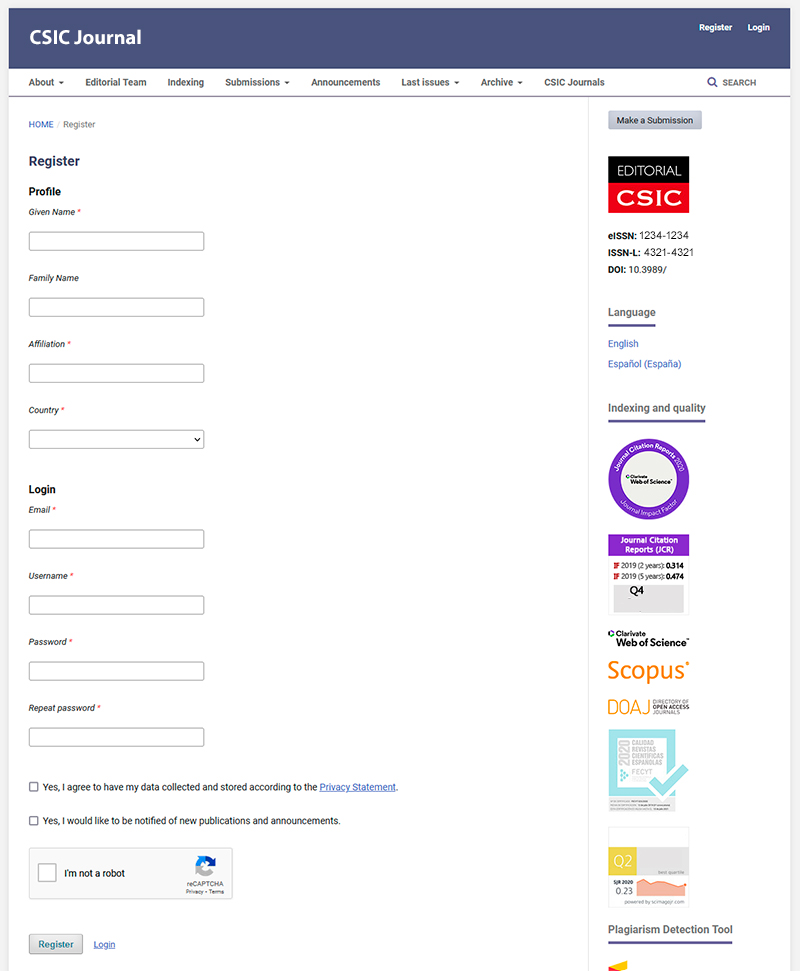
3.- You will receive a message with a link to activate your account at the provided email address. Once activated, you will be able to log in to your account with the credentials you created.
How to send an original manuscript to Informes de la Construcción
1.- On the magazine's website, log in by clicking on "Login":

2.- Enter your username and password. Once you return to the magazine's homepage, click on the "Make a Submission" button:

Before submitting, please review the "Submission Preparation Checklist" and read the "Author Guidelines", the "Copyright Notice" and the "Privacy Statement". When you have all the required documents ready, click on the link "Make a new submission".
In subsequent logins, you will be taken to your user dashboard. There press the ‘New Submission’ button to submit a new article. You will be shown any articles received and in process under the ‘My Queue’ tab):

3.- As you will see on the new submissions page, submitting a manuscript is a four-stage process, in addition to a final section with information on follow-up:
3.1.- "1. Start"
At this stage you must select the language in which the article is written and the section of the journal in which you think it would fit, you must indicate that you have prepared all the items on the "Submission requirements" list and, optionally, you may send comments to the editor. You must comply with the terms of the Copyright Statement and the collection and storage of your data as the author of the article in accordance with the Privacy Statement of the Consejo Superior de Investigaciones Científicas (CSIC).
Then press the "Save and continue" button.
3.2.- "2. Upload submission"
In this phase, the files that make up the article and its additional documentation will be uploaded to the management module.
There are three parts to upload each file. In the first one, we will select which component of the article we are going to contribute and we will upload the corresponding file. Once uploaded, click on the "Continue" button. In the second part we will see the file metadata, with the possibility to edit them, but we will click "Continue" without making this edition.
In the third part, select "Add Another File", going back to "1. Upload file" and, without modifying the default option "This is not a revision of an existing file", select the new "Article Component" identifying what it is and uploading the file. Click "Continue" until you reach, once again, step "3. Confirm". This process must be repeated until all the files have been sent, and only when all the material has been uploaded should the "Complete" button be selected.
If after "Completing" the submission we realise that we have forgotten to upload a file, we can do so by selecting the "Upload File" button located in the upper right-hand corner of the "2. Upload Submission" tab:

Once all the submission files have been uploaded, we will press the "Save and continue" button.
3.3.- "3. Enter Metadata"
In this phase the author will enter the metadata of the article according to the journal guidelines. These are:
- Title in Spanish and English. If the article is written in another language, it will be introduced first this language and then in English.
- Summary or abstract in the same languages as the previous item.
- List of contributors. Although it was not necessary when registering as a journal user, in this section it is compulsory for authors to have their ORCID identifier and affiliation correctly indicated. If necessary, the information of additional authors will be added using the link "Add contributor":

- Keywords. The article keywords will be inserted in both languages. The entire list cannot be copied, must be entered one term at a time pressing "Enter" after each one.
- Funding data. The entities that have supported the research published in the article must be indicated. After selecting "Add funder", the name of the funder should be inserted again, which will trigger an internal search that will return the institution standardised name and DOI. If the institution does not have a DOI, it will not be able to register in this field. After entering the grant numbers, click on "Save".
To finish this phase of entering metadata, click on the "Save and continue" button.
3.4.- "4. Confirmation" y "5. Next steps"
In this last phase we will confirm the submission metadata recording linked to the uploaded files. Before clicking on the "Finish Submission" button, we can go back to the previous phases and review the information and files provided to check that they are all correct.
Once we click on the "Finish Submission" button, the article will be sent to the journal and its staff will contact you to continue with the process, as indicated in the "5. Next Steps" section.
How to check a revision report and submit a revised version of a manuscript
Once your submission has been reviewed, the journal's staff will send you a review report. Once received, you must log in to the journal and, in the "Submissions" section of your dashboard, you will be able to check that your submission is in the Review phase and, if the editorial staff has requested, whether it is necessary to make any modifications or revisions to the manuscript:

By clicking on the title of your submission, you will be taken to the workflow of your submission and you will be able to check the information related to the its review. You will find the notifications that the editorial staff has sent you, the attachments that the reviewers may have attached and, if requested, the possibility to provide a new version of the manuscript with the requested modifications by clicking on the "Upload file" button:

Research data policy
We recommend authors depositing data obtained from the research developed for the preparation of their article in repositories of recognized prestige, specific to the discipline or of a generalist nature. In any case, it must be a FAIR repository (Findable, Accessible, Interoperable, Reusable), preferably in open access.
There are several repositories destined to conserve and disseminate concrete data such as results of surveys, observations, interviews, simulations, automatically collected data, samples, models ... If necessary, authors can consult the Registry of Research Data Repositories re3data taking into account that each repository has its own deposit rules.
Those CSIC authors who would like to deposit their datasets in Digital.CSIC may do so by following these guidelines. They can use the Servicio de Archivo Delegado made available by the Technical Office of DIGITAL.CSIC and the Red de Bibliotecas CSIC.
DIGITAL.CSIC generates DOIs for datasets and associated software and is certified as data repository in re3data and Repository Finder. More information at Política de datos en Digital.CSIC.
If the author has deposited datasets in a repository, he should mention it in the article providing a brief description of the type of data deposited, the name and URL of the repository, the identification code and the data of the license for use and distribution. This information must be included at the end of the article, immediately before the bibliographic listing, under the heading "Data availability".
Download HERE the Good Practice Code in PDF
Download HERE the Authorship Form in PDF
Copyright Notice
© CSIC. Manuscripts published in both the printed and online versions of this Journal are the property of Consejo Superior de Investigaciones Científicas, and quoting this source is a requirement for any partial or full reproduction.All contents of this electronic edition, except where otherwise noted, are distributed under a “Creative Commons Attribution 4.0 International” (CC BY 4.0) License. You may read here the basic information and the legal text of the license. The indication of the CC BY 4.0 License must be expressly stated in this way when necessary.
Self-archiving in repositories, personal webpages or similar, of any version other than the published by the Editor, is not allowed.
Privacy Statement
The Spanish National Research Council (CSIC) has a record of data processing activities. Data collected through this form will be incorporated and processed in the “Gestión de las actividades de producción y distribución de las publicaciones del CSIC” processing activity of Editorial CSIC in order to manage the requested service. It is the responsibility of Editorial CSIC to manage this record. If you wish to exercise your rights, please contact us through the postal address Vitruvio, 8, 28006 Madrid, Spain or e-mail address editorialcsic@csic.es. The data processing is legitimized by the consent of the person concerned. The data may not be transferred to third parties except in the cases provided for in current regulations on the protection of personal data. You have the right to file a claim with the Spanish Data Protection Agency. You have the right to withdraw your consent. If you wish to do so or to exercise your rights of access, deletion, rectification, limitation or portability, you can do so through this form. You can also contact the CSIC Officer for Data Protection via e-mail: delegadoprotecciondatos@csic.es


