Earthen construction in the 21rst century
DOI:
https://doi.org/10.3989/ic.10.046Keywords:
earthen construction, sustainable materials, innovation, rammed earth, adobeAbstract
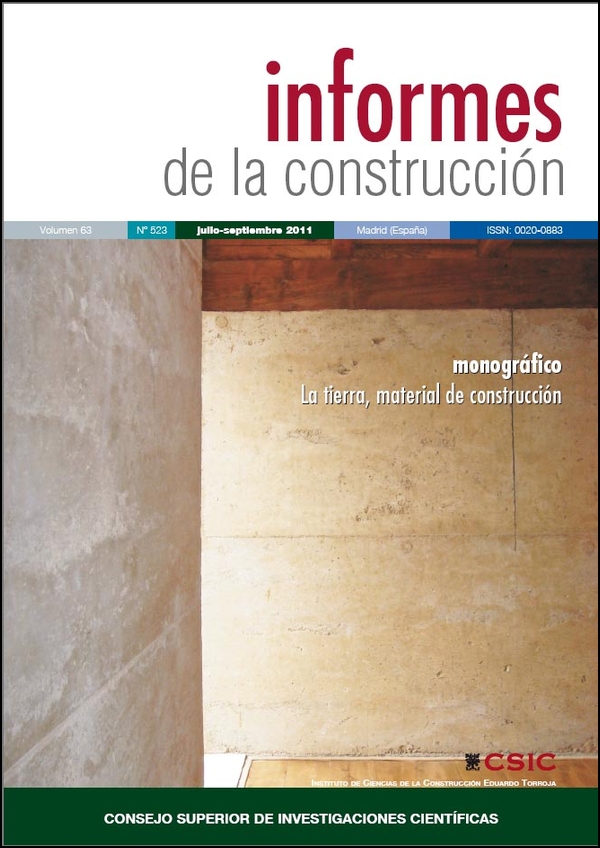
Earthen construction during the 21rst century first decade has resurfaced worldwide as a sustainable, low environmental impact and great expressive material. The research and the number of projects has been increased related to the growth of the associations, institutions, universities and events surrounding this sector. These projects have managed to modernize the traditional techniques of building with earth in order to adapt them to today’s projecting needs, and have been widely recognized for its quality. The aim of this article is to provide a global view on earth construction internationally, providing technical data of its utilization in contemporary architectural projects.
Downloads
References
(1) Algorri, E.: “La construcción con tierra en el Código Técnico de la Edificación”. Más es menos, Construir en Barro. Una Arquitectura de Futuro (2009). Centro de Estudios Benaventanos Ledo del Pozo. ISBN: 978-84-936651-4-2.
(2) Rauch, M.; Kapfinger, O.: Rammed Earth, Lehm un Architektur. Ed. Birkhäuser, Basel, 2001. ISBN 3-7643-6461-0.
(3) Maldonado, L.; Vela Cossío, F.; Hoz, J.: Diccionario de construcción tradicional. Tierra. Editorial Nerea, San Sebastián, 2003. ISBN: 84-89569-80-0.
(4) Bauluz, G.; Bárcena, P.: Bases para el diseño y construcción con tapial. Ministerio de Obras Públicas y Transportes, Madrid, 1992. ISBN 8474338395.
(5) Smallcombe, J.; Abey, J.: ‘’Cob bus shelter at the Eden Project’’. Devon Earth Building Association newsletter, Issue spring (2005), pp. 5-9.
(6) Normativa de construcción con tierra neozelandesa NZ 4297:1998.
(7) Ficha técnica del Bloque BTC Bioterre, fabricante: Grup Planas.
(8) Font, F.; Hidalgo, P.: Arquitecturas de Tapia. Col.legi Oficial d’Aparelladors i Arquitectes Tècnics de Castelló, Castellón, 2010. ISBN 978-84-613-3143-7.
(9) Walker, P.; Keable, R.; Martin, J.; Maniatidis, V.: Rammed Earth, Design and construction guidelines. Ed. BRE Bookshop, 2005. ISBN 1-86081-734-3.
(10) Rael, R.: Earth architecture. Ed. Princeton Architectural Press, Nueva York, 2009. ISBN 978-1-56898-767-5.
(11) Guigou, C.: La tierra como material de construcción. Colegio Oficial de arquitectos de Canarias, 2002. ISBN: 84-600-9721-8.
(12) Domínguez Alonso, M.: “Propiedades térmicas de los adobes”. Ponencia presentada en el IX Encuentro Internacional de Trabajo Navapalos, (1994). Publicado en Arquitectura de tierra. Encuentros Internacionales de Navapalos. Centro de Publicaciones Ministerio de Fomento, Madrid, 1999. ISBN 84-498-0387-X.
(13) Catálogo de soluciones cerámicas. Hyspalit e Instituto de Ciencias de la Construcción Eduardo Torroja, Madrid, 2008. Dep. legal M-41050-2008.
(14) Código técnico de la edificación. Código Técnico de la Edificación. Real Decreto 314/2006. Ministerio de Vivienda. DBSI.
(15) Código técnico de la edificación. Código Técnico de la Edificación. Real Decreto 314/2006. Ministerio de Vivienda. DBHR.
(16) Bobes, A.: Les eines del bioclimatisme. Escola Sert, Barcelona, 2007.
(17) Hegger, M.; Auch-Schwelk, V.; Fuchs, M.; Rosenkranz, T.: Construction materials manual. Ed. Birkhäuser, Basel, 2005. ISBN-10: 3-7643-7570-1.
Downloads
Published
How to Cite
Issue
Section
License
Copyright (c) 2011 Consejo Superior de Investigaciones Científicas (CSIC)

This work is licensed under a Creative Commons Attribution 4.0 International License.
© CSIC. Manuscripts published in both the print and online versions of this journal are the property of the Consejo Superior de Investigaciones Científicas, and quoting this source is a requirement for any partial or full reproduction.
All contents of this electronic edition, except where otherwise noted, are distributed under a Creative Commons Attribution 4.0 International (CC BY 4.0) licence. You may read the basic information and the legal text of the licence. The indication of the CC BY 4.0 licence must be expressly stated in this way when necessary.
Self-archiving in repositories, personal webpages or similar, of any version other than the final version of the work produced by the publisher, is not allowed.