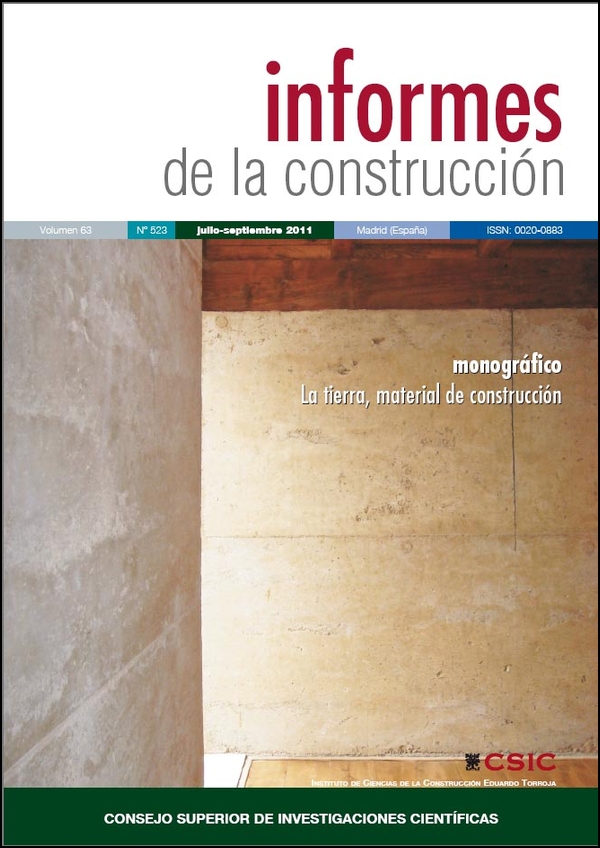
Rendering and finishing on contemporary earth building
DOI:
https://doi.org/10.3989/ic.10.019Keywords:
render, wall, earth, construction, clay (mud)Abstract
Earth construction is in increasing demand in some areas of building activity, which means a need for technical solutions to maintain and preserve the properties of earth walls. Like earth wall construction techniques themselves, materials used for rendering (plastering, painting, panelling, etc) have evolved in a way that allows us to find formal solutions suitable for every architectural situation. This paper deals with the special features of each rendering technique available in contemporary construction, from renderings permitting earth wall textures and finish to be appreciated, to plasters from different materials. Special attention will be focused on clay plasters, which are more appreciated due to its natural characteristics and compatibility with the base wall. The explanations are supported by different examples of buildings where these techniques have been used during the last two decades.
Downloads
References
(1) Romero Taylor, G.: “An evaluation of the New Mexico state monuments test walls at Fort Selden”. Adobe 90. preprints. 6th International conference on the conservation of earthen architecture (1990), pp. 383-389. Getty Conservation Institute.Los Angeles, Las Cruces, Nex Mexico.
(2) Chiari, G.: “Ethyl Silicate treatments and Humidity”. Terra 93 (1993), pp. 422-425.
(3) Beas Guerrero de Luna, M. I.: “Consolidation of traditional plasters: A laboratory research”. Terra 93. Comunicaçôes. 7ª conferencia internacional sobre o estudo e conservaçao da arquitetura de terra (1993), pp. 410-416. Direcçâo Geral dos Edifiçios e Monumentos Nacionais, Lisboa.
(4) Facey, W. Back to earth. Adobe building in Saudi Arabia. pp. 145-146, Al-Turath, Riyadh, 1997.
(5) Torres Soria, P.; Cedillo Álvarez, L.: “La goma de nopal: una aportación para la conservación de arquitectura de tierra seca protegida por la techumbre”(2003). NRPC – INAH. http://www.conservacionyrestauracion.inah.gob.mx/html/correo_restaurador/html/CORE0411.html
(6) Minke, G. Lehmbau - Handbuch. Ökobuch. Freiburg, 1994: Earth Construction Handbook. WITpress, Southampton, 2000 (traducción del anterior) y Manual de construcción en tierra, pp. 114-116, Fin de Siglo, Uruguay, 2008.
(7) Castilla, F.: “Estabilización de morteros de barro para la protección de muros de tierra (mejora de la durabilidad)”. Actas de las I Jornadas de Investigación en Construcción (2005), pp. 717-737. Instituto de Ciencias de la Construcción “Eduardo Torroja”, Madrid.
(8) Merill, A. F.: Casas de tierra apisonada (The rammed-earth house). traducido por Jose Luis Moia, Universidad Nacional de Buenos Aires. Ed Windsor, Buenos Aires, 1948.
(9) Hunter, T.: “Building with adobe and stabilized- earth blocks”. United States Department of Agriculture. Leaflet 535 (1978). Washington.
(10) Minke, G.; Ziegler, K.: “The requirements for interior clay plasters”. Actas del congreso “Lehm 2008” (2008), pp. 23-31. Organizado por Dachverband Lehm e.V, Koblenz.
(11) Castilla, F.: “La técnica del Tapial en la Construcción Tradicional de la Provincia de Albacete”. Revista Zahora. Volumen nº 45 (2006), p. 37. Diputación provincial de Albacete.
Downloads
Published
How to Cite
Issue
Section
License
Copyright (c) 2011 Consejo Superior de Investigaciones Científicas (CSIC)

This work is licensed under a Creative Commons Attribution 4.0 International License.
© CSIC. Manuscripts published in both the print and online versions of this journal are the property of the Consejo Superior de Investigaciones Científicas, and quoting this source is a requirement for any partial or full reproduction.
All contents of this electronic edition, except where otherwise noted, are distributed under a Creative Commons Attribution 4.0 International (CC BY 4.0) licence. You may read the basic information and the legal text of the licence. The indication of the CC BY 4.0 licence must be expressly stated in this way when necessary.
Self-archiving in repositories, personal webpages or similar, of any version other than the final version of the work produced by the publisher, is not allowed.