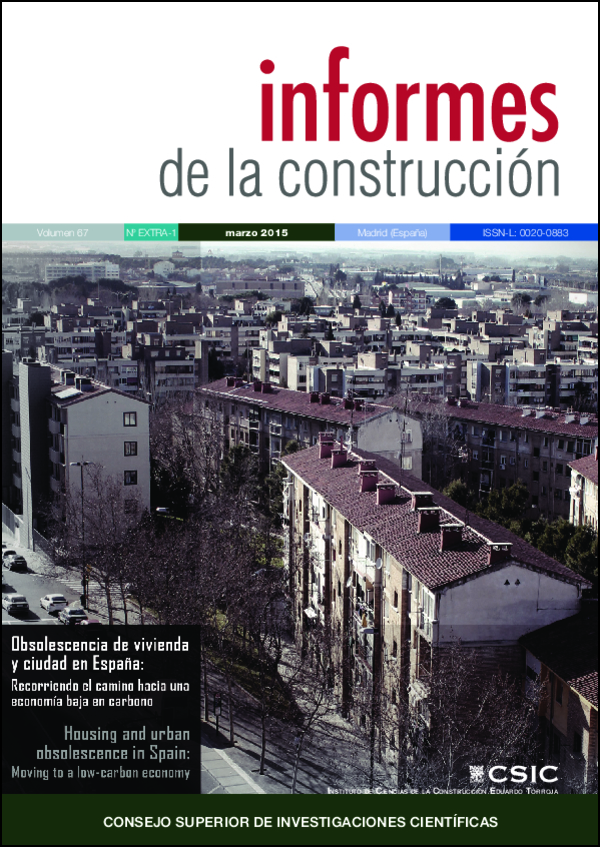
Housing typologies obsolescence of the residential estates built between 1950 and 1976. Mismatches with contemporary socio-cultural reality
DOI:
https://doi.org/10.3989/ic.14.045Keywords:
Urban obsolescence, housing estates, social housing, architecture during Franco’s regimeAbstract
The paper focuses on housing typologies as one of the main reasons for the current obsolescence of the so called “polígonos residenciales”. These housing estates were relatively homogeneous, due to the fact that they were the result of processes determined and controlled by the government through laws, norms and regulations, mostly during the decade of the 1950s. The author contends that the architectural typologies derived from these prescriptions contribute to their obsolescence because nowadays they present a mismatch with contemporary social and cultural reality. The article is structured around two points. The first one reflects upon the evolution of the thinking and the process of experimentation that preceded the mass construction of the “polígonos residenciales” in the 1960s and 1970s. The second one identifies and discusses five main mismatches between their housing typologies and contemporary needs.
Downloads
References
(1) Sambricio, C. (2004). Madrid, vivienda y urbanismo: 1900-1960, Madrid: Akal.
(2) Sambricio, C. (Coordinador). (1999). La vivienda en Madrid en la década de los 50. El Plan de Urgencia Social, Madrid: Electa.
(3) Ferrer i Aixalà, A. (1996). Els poligons de Barcelona, Barcelona: Universitat Politècnica de Catalunya.
(4) Sambricio, C. (Editor). (2003). Un siglo de vivienda social 1903-2003, Madrid: Nerea.
(5) Sambricio, C., Sánchez Lampreave, R. (Editores). (2008). 100 años de historia de la intervención pública en la vivienda y la ciudad, Madrid: Asociación Española de Promotores Públicos de Vivienda y Suelo (AVS).
(6) Álvarez, E. (1961). Viviendas amparadas por el estado. Recopilación de las legislaciones vigentes sobre viviendas baratas y económicas, Madrid: Boletín Oficial del Estado.
(7) Bergera, I. (2008). Obra Sindical del Hogar: tres décadas de vivienda social. En Sambricio, C., Sánchez Lampreave, R. (Editores), 100 años de historia de la intervención pública en la vivienda y la ciudad (pp. 121-143). Madrid: Asociación Española de Promotores Públicos de Vivienda y Suelo (AVS).
(8) Azpiri, A. (2000). La aportación del Colegio Oficial de Arquitectos Vasco-Navarro a la V Asamblea Nacional de Arquitectos, en el año 1959. En: Pozo, J.M. (Coord.), Los años 50: la arquitectura española y su compromiso con la historia (pp. 101-107). Pamplona: Escuela Técnica Superior de Arquitectura de la Universidad de Navarra.
(9) Sambricio, C. (2000). La vivienda española en los años 50. En: Pozo, J.M. (Coord.), Los años 50: la arquitectura española y su compromiso con la historia (p. 46). Pamplona: Escuela Técnica Superior de Arquitectura de la Universidad de Navarra.
(10) López de Lucio, R. (2003). De la manzana cerrada al bloque abierto. En: Sambricio, C. (Ed.), Un siglo de vivienda social 1903-2003 (tomo II) (p.161-166). Madrid: Nerea.
(11) Arrese, J. L. (1959). Política de vivienda (textos y discursos), Madrid: Ministerio de la Vivienda.
(12) Roch, F. (2003). El sector privado y la construcción de viviendas sociales. En: Sambricio, C. (Ed.) (2003), Un siglo de vivienda social 1903-2003 (tomo II) (pp. 170-173). Madrid: Nerea.
(13) Peremiquel, L. (2000). Vivienda, innovación y proyecto. Necesidades, nuevas tecnologías y estrategias proyectuales, Barcelona: Collegi d’Arquitectes de Catalunya.
(14) Montaner, J. M., Muxí, Z. (2006). Habitar el Presente. Vivienda en España: sociedad, ciudad, tecnología y recursos, p. 20-57, Madrid: Ministerio de Vivienda.
Published
How to Cite
Issue
Section
License
Copyright (c) 2015 Consejo Superior de Investigaciones Científicas (CSIC)

This work is licensed under a Creative Commons Attribution 4.0 International License.
© CSIC. Manuscripts published in both the print and online versions of this journal are the property of the Consejo Superior de Investigaciones Científicas, and quoting this source is a requirement for any partial or full reproduction.
All contents of this electronic edition, except where otherwise noted, are distributed under a Creative Commons Attribution 4.0 International (CC BY 4.0) licence. You may read the basic information and the legal text of the licence. The indication of the CC BY 4.0 licence must be expressly stated in this way when necessary.
Self-archiving in repositories, personal webpages or similar, of any version other than the final version of the work produced by the publisher, is not allowed.