The potential of the new legal framework to promote urban renewal and regeneration at the regional and local levels
DOI:
https://doi.org/10.3989/ic.14.072Keywords:
Refurbishment and urban regeneration, local and regional level, managementAbstract
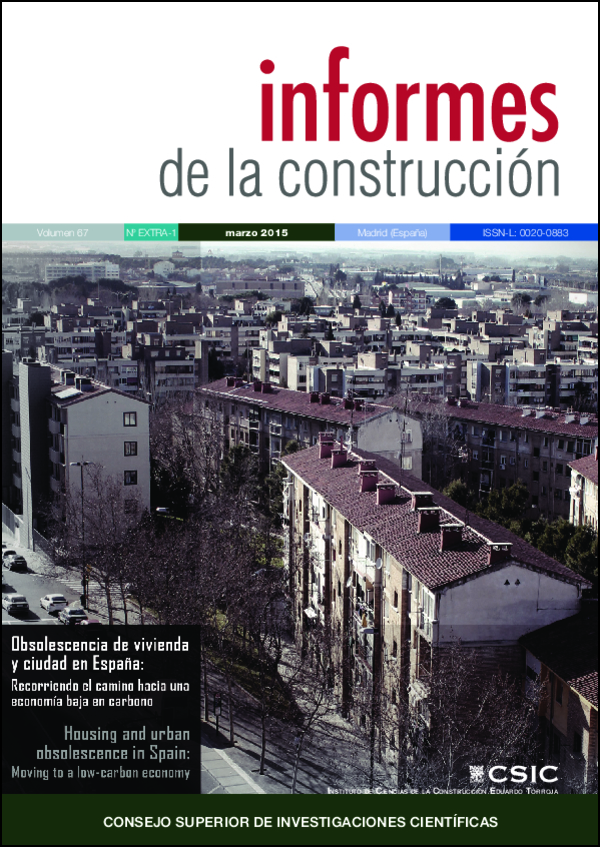
The new legal framework (Act 8/2013) offers intervention possibilities in the housing sector at both the local and regional levels. If not implemented at these levels, a golden opportunity to confirm the possible results of this new law on today’s largely obsolete building sector will be missed, especially considering that at this very challenging time stimulating political and investment measures is of vital importance. Examining the experience in Zaragoza, we propose some management formulas to promote refurbishment and urban renewal: support during the very first stages of the process, the creation of mixed (public-private) entities, and the securing of European funding.
Downloads
References
(1) Rubio, J. (2011), Rehabilitación Urbana en España (1989-2010).Barreras actuales y sugerencias para su eliminación, Informes de la Construcción, 63(EXTRA), 5-20.
(2) Rubio, J. (2013), La rehabilitación integral de algunos conjuntos urbanos de Zaragoza. Una oportunidad para el reciclado de la ciudad. En En Tejedor Bielsa, J. (Ed.), Rehabilitación y regeneración urbana en España. Situación actual y perspectivas. Monografías de la Revista aragonesa de Administración Pública, XV: 237-282.
(3) Parkinson, M. (2014), Regeneración Urbana Integrada en 2014: nada nuevo bajo el sol y que pasa con España. En Menéndez, A. (Coord.), Por la rehabilitación, la regeneración y la renovación urbanas, Número monográfico de Ciudad y Territorio. Estudios territoriales, 2014(179): 11-27.
(4) Kleva, M. (2013), Informe sobre la aplicación y el impacto de las medidas de eficiencia energética en el marco de la política de cohesión (2013/2038(INI)), Comisión de Desarrollo Regional, Presentado al Parlamento europeo en la sesión del 17/07/2013.
(5) de la Cruz Mera, Á. (2014), La ley 8/2013 de 26 de junio, de rehabilitación, regeneración y renovación urbanas. En Menéndez, A. (Coord.), Por la rehabilitación, la regeneración y la renovación urbanas, Número monográfico de Ciudad y Territorio. Estudios territoriales, 2014(179): 29-40.
(6) Vegara, A., de las Rivas, J.L. (2004), Territorios Inteligentes, p. 156, Madrid: Fundación Metrópoli.
(7) Ponce, J. (2013), Políticas públicas para afrontar la regeneración urbana de barrios degradados. Una visión integrada desde el Derecho. Revista Aragonesa de Administración Pública, 2013(41-42): 11-70.
(8) Hermant-de Callatay, C., Svanfeldt, C. (2011). Ciudades del Mañana. Retos, visiones y caminos a seguir, Comisión Europea, Dirección General de Política Regional. http://ec.europa.eu/regional_policy/sources/docgener/studies/pdf/citiesoftomorrow/citiesoftomorrow_final_es.pdf.
(9) Ruiz, L. G., Rubio, J. (2006). Estudio y propuestas de rehabilitación de 21 Conjuntos Urbanos. Nuevas propuestas de rehabilitación urbana en Zaragoza. Zaragoza: Sociedad Municipal de Rehabilitación Urbana de Zaragoza.
(10) Hernández Aja, A. (2010). Análisis urbanístico de Barrios Vulnerables en España. Sobre la Vulnerabilidad Urbana. España: Instituto Juan de Herrera, Ministerio de Fomento. http://www.fomento.gob.es/NR/rdonlyres/C88DB66D-8669-497C-BEE4-442AE027E2FB/111287/SOBRE_vulnerabilidad.pdf.
Published
How to Cite
Issue
Section
License
Copyright (c) 2015 Consejo Superior de Investigaciones Científicas (CSIC)

This work is licensed under a Creative Commons Attribution 4.0 International License.
© CSIC. Manuscripts published in both the print and online versions of this journal are the property of the Consejo Superior de Investigaciones Científicas, and quoting this source is a requirement for any partial or full reproduction.
All contents of this electronic edition, except where otherwise noted, are distributed under a Creative Commons Attribution 4.0 International (CC BY 4.0) licence. You may read the basic information and the legal text of the licence. The indication of the CC BY 4.0 licence must be expressly stated in this way when necessary.
Self-archiving in repositories, personal webpages or similar, of any version other than the final version of the work produced by the publisher, is not allowed.