About to the gypsum
DOI:
https://doi.org/10.3989/ic.2004.v56.i493.435Abstract
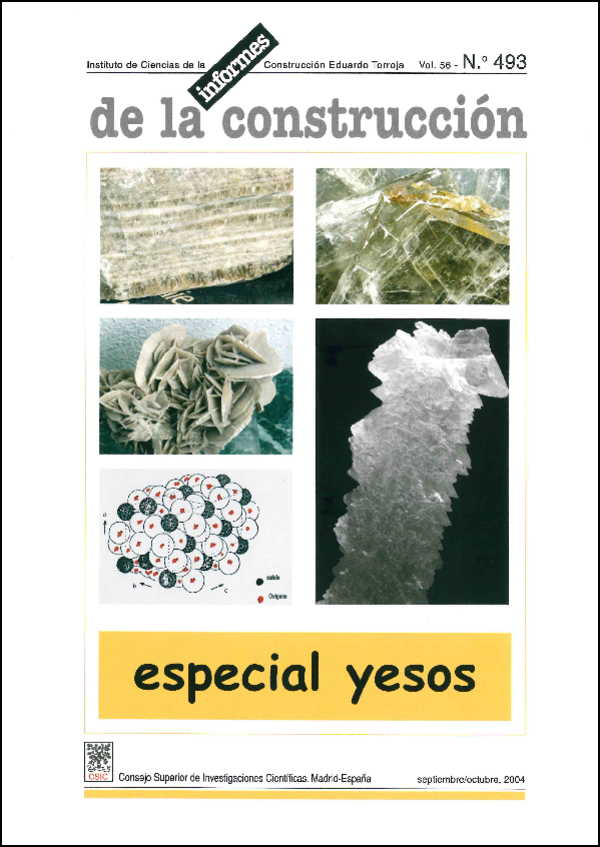
The word “IESO” (old Spanish for plaster) appeared in Sebastián de Covarrubias 1611 (Thesaurus of the Castilian or Spanish language), the first dictionary of the Spanish language, where it was defined as follows: “a certain kind of rock, not hard; one very shiny variety that glitters like glass is called mirror rock”.
The general term “YESO” (modern Spanish) has two different meanings. On the one hand, it refers to gypsum, a mineral particularly abundant in Spain (where it is the main constituent of 11.5 per cent of the country’s surface ground), and on the other to the industrial product obtained from gypsum, namely plaster.
Downloads
Downloads
Published
How to Cite
Issue
Section
License
Copyright (c) 2004 Consejo Superior de Investigaciones Científicas (CSIC)

This work is licensed under a Creative Commons Attribution 4.0 International License.
© CSIC. Manuscripts published in both the print and online versions of this journal are the property of the Consejo Superior de Investigaciones Científicas, and quoting this source is a requirement for any partial or full reproduction.
All contents of this electronic edition, except where otherwise noted, are distributed under a Creative Commons Attribution 4.0 International (CC BY 4.0) licence. You may read the basic information and the legal text of the licence. The indication of the CC BY 4.0 licence must be expressly stated in this way when necessary.
Self-archiving in repositories, personal webpages or similar, of any version other than the final version of the work produced by the publisher, is not allowed.