Characterization and recovery proposal of polymer mortar coating plates of the parish of San Pablo in Seville
DOI:
https://doi.org/10.3989/ic.16.026Keywords:
polymer mortar, resin, coating plates, restorationAbstract
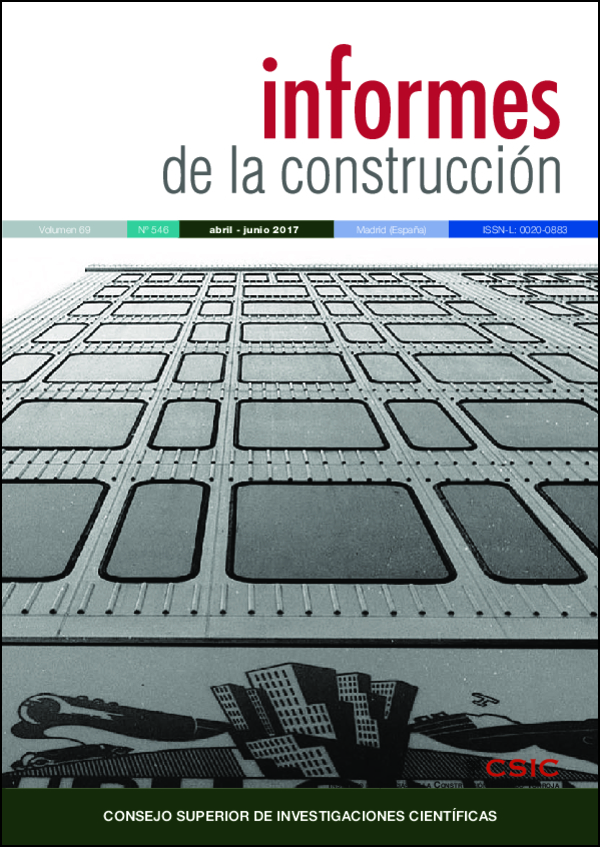
This paper deals with the study of the facade elements of the parish of San Pablo in Seville (1961). They are made with polymer mortar. A characterization of the coating plates was carried out and possible solutions for recovering the altered material were analyzed in order to facilitate a future intervention. The resins used as a binder were identified as aliphatic polyester. The resin study was carried out to assure the compatibility of restoration products. Materials characterization provides information about the structural capacity of the plates and the properties achieved. The plates’ colorimetric control is an inexcusable necessity, since any action on the surface of the pieces leads to a color change. All the analyses and testing carried out have led to the creation of an appropriate treatment system for recovery of the plates that provides sufficient information to the intervention project managers to justify decision-making.
Downloads
References
(1) Capilla Roncero. I., Sánchez-Cid, J. I., Ramos Carranza, A. (2003). Arquitectura del Racionalismo en Sevilla: inicios y continuidades. En II Seminario de la Arquitectura (pp. 20-34). Sevilla: FIDAS, COAS.
(2) Yá-ez Sempere, J. L., García Torrente, U., Reina Fernández, J. C. (1992). Guía de la arquitectura de Sevilla y área metropolitana s. XX, Sevilla: Colegio Oficial de Arquitectos de Andalucía Occidental.
(3) López de Asiaín, J., Mosquera, E. (1996). El espíritu de la tercera generación en la arquitectura sevillana de los a-os 60, Sevilla: ETS Arquitectura de Sevilla, 1996.
(4) http://www.iaph.es/arquitectura-contemporanea-andalucia/resumen.do?id=252466.
(5) Kamal, M. M., Tawfik, S. Y., Nosseir, M. H. (1987). Polyester mortar. Jour. Appl. Polymer Science, 33: 1609-1622. https://doi.org/10.1002/app.1987.070330516
(6) Grassie, N., Marilyn, I. G. (1985). Degradation of epoxy polymers: 3-Photo-degradation of bisphenol-A diglycidyl ether. Polymer Degradation and Stability, 13(3): 249-259. https://doi.org/10.1016/0141-3910(85)90012-6
(7) Corpas, F. A., Codina, S., Ruiz Román, J. M., Ruiz Prieto, J. M., Alonso Santos. C. (2002). Characterization of material composite marble-polyester. Materiales de Construcción, 52(268): 65-71. https://doi.org/10.3989/mc.2002.v52.i268.318
(8) Ahmetli, G., Dag, M., Deveci, H., Kurbanli, R. (2011). Recycling Studies of Marble Processing Waste: Composites Based on Commercial Epoxy Resin. Jour. Appl. Polymer Science, 125(1).
(9) Silva, M. A. G., Silva Z. C. G. (2007). Degradation of mechanical characteristics of some polymeric mortars due to aging. ACI Materials Jour., 104(4): 337-343.
(10) Silva, Z. C. G., Simao, J. (2007). Petrographic and mechanical aspects of accelerated ageing of polymeric mortars. Cement and Concrete Composites, 29(2): 146-156. https://doi.org/10.1016/j.cemconcomp.2006.08.003
(11) Tam, L., Lau D. (2015). Moisture effect on the mechanical and interfacial properties of epoxy-bonded material system: An atomistic and experimental investigation. Polymer, 57(28): 132-142. https://doi.org/10.1016/j.polymer.2014.12.026
(12) Zoghlami, K., Gómez-Gras, D., Álvarez, A., De Luxán, M. P. (2005). Evaluation of consolidating and water repellent treatments applied to the miocene sandstone used in Tunisian Heritage Monuments. Materiales de Construcción 55(277): 25-39.
(13) Villegas, R., Vale, F. J., Alcalde, M. (1991). Study of water-repellent treatments applied on limestone from Andalusian Cathedrals. Materiales de Construcción, 41(223): 19-27. https://doi.org/10.3989/mc.1991.v41.i223.737
(14) Luque, A., Cultrone, G., Sebastián, E., Cazalla, O. (2008). Effectiveness of stone treatments in enhancing the durability of bioclastic calcarenite in (Granada, Spain). Materiales de Construcción, 58(292): 115-128.
(15) AENOR (1996). UNE-EN 933-2. Ensayo para determinar las propiedades geométricas de los áridos. Parte 2: Determinación de la granulometría de las partículas. Tamices de ensayo, tama-o nominal de las aberturas. Asociación Española de Normalización (AENOR).
(16) AENOR (2008). UNE-EN-13755:2008 Métodos de ensayo para piedra natural. Determinación de la absorción de agua a presión atmosférica. Asociación Española de Normalización (AENOR).
(17) AENOR (2007). UNE-EN-1936:2007 Métodos de ensayo para piedra natural. Determinación de la densidad real y aparente y de la porosidad abierta y total. Asociación Española de Normalización (AENOR).
(18) AENOR (2007). UNE-EN-12372:2006 Métodos de ensayo para piedra natural. Determinación de la resistencia a la flexión bajo carga concentrada. Asociación Española de Normalización (AENOR).
(19) Cerezo, A., Mas-Barber, X., Kröner, S. (2014). Study of the mechanical properties of mortars based on organic binders used in the reproduction of outdoor artworks. En Eur. Network for Conservation and Restoration Symp. Liège, Belgique.
(20) Drdácky, M., Lesák, J., Rescic, S., Slízkova, Z., Tiano, P., Valach, J. (2012). Standardization of peeling tests for assessing the cohesion and consolidation characteristics of historic stone surfaces. Materials and Structures, 45: 505-520. https://doi.org/10.1617/s11527-011-9778-x PMid:27656103 PMCid:PMC5012354
(21) Espinosa-Gaitán, J., Martín-Chicano, A. (2016). A comparison of three methods of consolidation, for clacerous mixed stones. En Hughes, J., Howind, T. (Eds.). Science and Art: A Future for Stone: Proceedings of the 13th International Congress on the Deterioration and Conservation of Stone, Volume 2 (pp. 745-752). Paisley: University of the West of Scotland.
(22) Chércoles, R., San Andrés, M., De la Roja, J. M., Gómez, M. L. (2010). Factores responsables de la degradación química de polímeros. Efectos provocados por la radiación lumínica sobre algunos materiales utilizados en conservación. En 11.ª Jor. Conservación de Arte Contemp. (pp. 331-358). Madrid (España): Ed. Museo Nacional Reina Sofía. PMid:21033904
(23) Doménech-Carbó, M. T., Silva, M. F., Aura-Castro, E., et al. (2011). Study of behaviour on simulated daylight ageing of artists' acrylic and poly(vinyl acetate) paint films. Anal and Bioanal Chem, 399: 2921-2937. https://doi.org/10.1007/s00216-010-4294-3 PMid:20981537
(24) Pacheco-Torgal, F., Ding, Y., Jalali, S. (2012). Properties and durability of concrete containing polymeric wastes (tyre rubber and polyethylene terephthalate bottles): An overview. Const and Build Mat, 30: 714-724. https://doi.org/10.1016/j.conbuildmat.2011.11.047
(25) Saikia, N., De Brito, J. (2012). Use of plastic waste as aggregate in cement mortar and concrete preparation: A review. Const and Build Mat, 34: 385-401, doi: https://doi.org/10.1016/j.conbuildmat.2012.02.066. https://doi.org/10.1016/j.conbuildmat.2012.02.066
(26) Ribeiro, M. C. S., Nóvoa, P. R., Ferreira, A. J. M., Marques, A. T. (2004). Flexural performance of polyester and epoxy polymer mortars under severe thermal conditions. Cement and Concrete Composites, 26(7): 803-809. https://doi.org/10.1016/S0958-9465(03)00162-8
(27) Berns, R. S. (2000). Billmeyer and Saltzman’s principles of color technology, New York, USA: Ed. Wiley-Interscience.
(28) Rodrigues, J. D., Grossi, A. (2007). Indicators and ratings for the compatibility assessment of conservation actions. Jour of Cult Heritage, 8: 32-43 https://doi.org/10.1016/j.culher.2006.04.007
Published
How to Cite
Issue
Section
License
Copyright (c) 2017 Consejo Superior de Investigaciones Científicas (CSIC)

This work is licensed under a Creative Commons Attribution 4.0 International License.
© CSIC. Manuscripts published in both the print and online versions of this journal are the property of the Consejo Superior de Investigaciones Científicas, and quoting this source is a requirement for any partial or full reproduction.
All contents of this electronic edition, except where otherwise noted, are distributed under a Creative Commons Attribution 4.0 International (CC BY 4.0) licence. You may read the basic information and the legal text of the licence. The indication of the CC BY 4.0 licence must be expressly stated in this way when necessary.
Self-archiving in repositories, personal webpages or similar, of any version other than the final version of the work produced by the publisher, is not allowed.