Glass fiber reinforced polyester in the works of Tous and Fargas
DOI:
https://doi.org/10.3989/id54733Keywords:
Tous & Fargas, GRP, Hypar, construction, plastic, light façadeAbstract
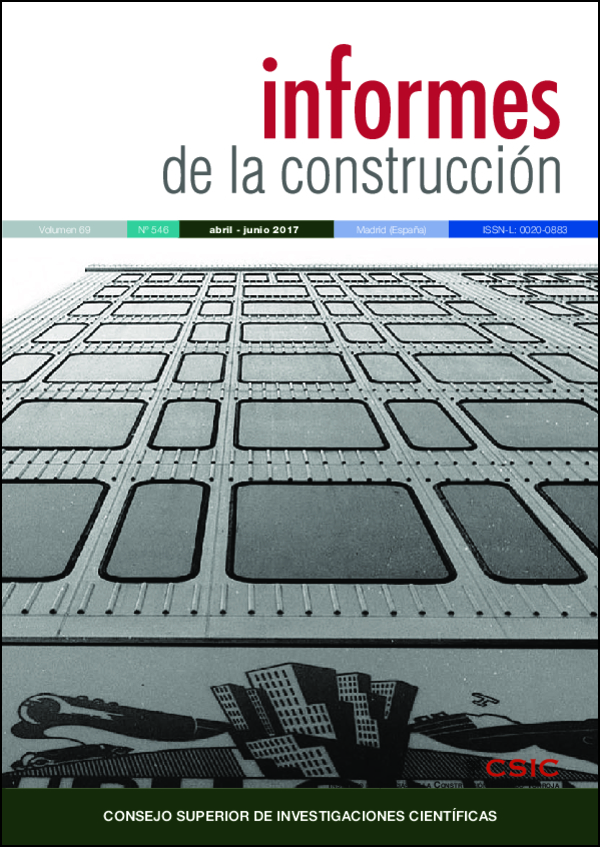
The architects Enric Tous (1925; t 1952) and Josep Maria Fargas (1926-2011, t 1952) achieved remarkable success during the 1960s and 1970s thanks to their commitment to technical experimentation and exploration of new construction systems. Among their most significant contributions is the incorporation of polyester reinforced with glass fiber as a material applied to solutions of light facades. This article tracks the origin, context, and results they obtained with this material. We propose an approach to the GRC material through the experience developed by the architects, analyzing the characteristics and specific implications of the systems proposed in their projects. Through this reading, the industrial initiative implemented by Tous and Fargas is put into value, and the key aspects that limited the progression of the construction system are detected.
Downloads
References
(1) AA. VV. (1987). Magatzem Spar. Quaderns d’aArquitectura i Urbanisme, 172(II): 54.
(2) Cusa, J. (1979). Aplicaciones del plástico en la construcción, p. 45, Barcelona: Ediciones CEAC.
(3) Quarmby, A. (1976). Materiales plásticos y arquitectura experimental, Barcelona: Gustavo Gili.
(4) Fargas Falp, J. M. (1999). Proyectar pensando en el mantenimiento: los edificios de oficinas. En El mantenimiento de los edificios. Desde el inicio del proyecto al final de la vida útil (pp. 86-87). Barcelona: COAC-UPC, Colección Papers Sert.
(5) Gómez Antón, M. R., Gil Bercero, J. (1997). Los plásticos y el tratamiento de sus residuos, Madrid: UNED.
(6) Cusa, J. (1979). Aplicaciones del plástico en la construcción, p. 146, Barcelona: Ediciones CEAC.
(7) Antequera, P., Jiménez, L., Miravete, A. (1991). Los materiales compuestos de fibra de vidrio, p 16, Zaragoza: Secretariado de Publicaciones de la Universidad de Zaragoza.
(8) Dietz, A. G. H. (1973). Plásticos para arquitectos y constructores, p. 117, Barcelona: Editorial Reverté.
(9) Quarmby, A. (1976). Materiales plásticos y arquitectura experimental, p. 42, Barcelona: Gustavo Gili.
(10) Richardson, T. L., Lockensgard, E. (2000). Industria del plástico – Plástico industrial, Madrid: Editorial Paraninfo.
(11) Rubin, I. (2003). Materiales plásticos. Propiedades y aplicaciones, p. 3, Ciudad de México: Editorial Limusa.
(12) Leggatt, A. (1984). GRP and Buildings. A design guide for architects and engineers, p. 3, Londres: Butterworths.
(13) Mateo García, M., Pérez-Carramiñana, C. (2012). Una casa del futuro finlandesa a orillas del Mediterráneo. RA Revista de Arquitectura, 14: 61.
(14) Díaz Moreno, C., García Grinda, E. (2005). Obsolescencia o reciclabilidad. Tectónica, 19: 6.
(15) Saechtiling, H. (1978). Los plásticos en la construcción, Barcelona: Gustavo Gili.
(16) Invenes. http://invenes.oepm.es [consulta 04/12/2013].
(17) Ruiz Collar, A. (1971). Memoria descriptiva del procedimiento para la obtención de elementos prefabricados de poliéster para la construcción. Patente de referencia P0391650 solicitada por Hypar, S. A. el 27/05/1971 y concedida el 11/12/1974. Oficina Española de Patentes y Marcas.
(18) AA. VV. (1979). Actas de las Segundas Jornadas de Plásticos para la Construcción: «Cerramientos e Interiorismo», Barcelona, 11 y 12 de diciembre de 1979 - Palacio de Congresos. Centro Español de Plásticos - Asociación de Industriales de Plásticos.
(19) Hernández Falagán, D. (2013). Técnica con mensaje. Tous y Fargas en el Paseo de Gracia. Proyecto, Progreso, Arquitectura, 8: 148-161.
(20) Cusa, J. (1979). Aplicaciones del plástico en la construcción, p. 236, Barcelona: Ediciones CEAC.
(21) Quarmby, A. (1976). Materiales plásticos y arquitectura experimental, p. 148, Barcelona: Gustavo Gili.
(22) Fargas Falp, J. M. (1999). Proyectar pensando en el mantenimiento: los edificios de oficinas. En El mantenimiento de los edificios. Desde el inicio del proyecto al final de la vida útil (p. 87). Barcelona: COAC-UPC, Colección Papers Sert.
Published
How to Cite
Issue
Section
License
Copyright (c) 2017 Consejo Superior de Investigaciones Científicas (CSIC)

This work is licensed under a Creative Commons Attribution 4.0 International License.
© CSIC. Manuscripts published in both the print and online versions of this journal are the property of the Consejo Superior de Investigaciones Científicas, and quoting this source is a requirement for any partial or full reproduction.
All contents of this electronic edition, except where otherwise noted, are distributed under a Creative Commons Attribution 4.0 International (CC BY 4.0) licence. You may read the basic information and the legal text of the licence. The indication of the CC BY 4.0 licence must be expressly stated in this way when necessary.
Self-archiving in repositories, personal webpages or similar, of any version other than the final version of the work produced by the publisher, is not allowed.