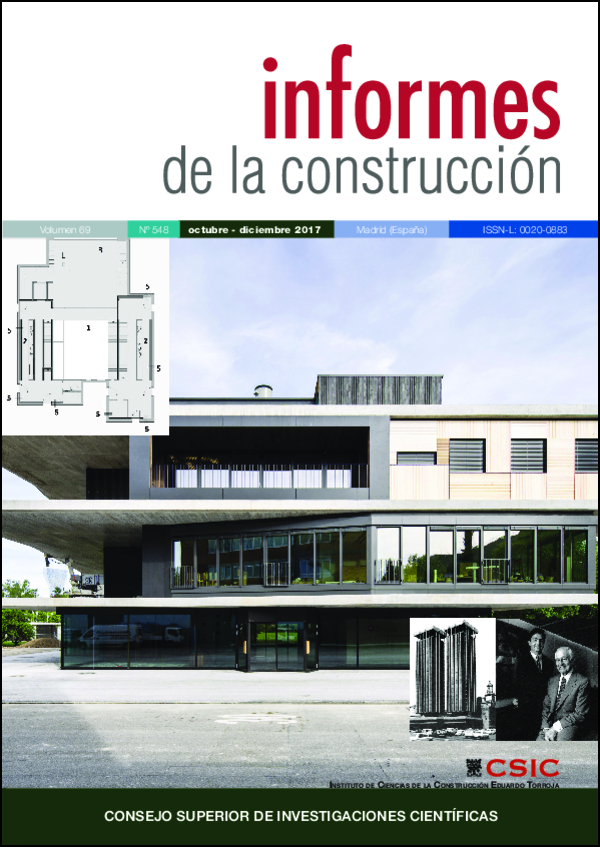
NEST – A platform for the acceleration of innovation in buildings
DOI:
https://doi.org/10.3989/id.55380Keywords:
open innovation, living lab, energy hub, water hubAbstract
The speed and quality of innovation in the construction sector has to be substantially increased in order to meet the pressing challenges associated with the building stock. For this purpose, the NEST project was started in Switzerland. NEST is a flexible and open research and technology transfer platform for partners from academia and industry where new solutions can be implemented and validated in a real life environment. NEST consists of a backbone, the static part, and research units which serve as office or living space where people live and work. Each unit is addressing specific research topics such as timber construction or digital fabrication and bears numerous innovation objects which are subject to continuous development and evaluation. NEST is a vertical neighbourhood of units, which are connected to a water hub and an energy hub. Once the research questions in a unit are answered and new products have been developed, the unit is deconstructed and replaced by a new unit addressing new topics.
Downloads
References
(1) Swiss Federal Office of Energy (2015). Analyse des schweizerischen Energieverbrauchs 2000-2014 nach Verwendungszweck, retrieved from http://www.bfe.admin.ch/themen/00526/00541/00542/02167/index.html?lang=de&dossier_id=02169 on March 15, 2017.
(2) Federal Office of the Environment (2016). Emissionen von Treibhausgasen nach revidiertem CO2-Gesetz und Kyoto-Protokoll, 2. Verpflichtungsperiode (2013–2020), retrieved from http://www.bafu.admin.ch/klima/13879/13880/14486/index.html?lang=de on March 15, 2017.
(3) Eawag (2017). Forum Chriesbach, retrieved from http://www.eawag.ch/en/aboutus/sustainability/sustainable-building/forum-chriesbach/ on March 15, 2017
(4) New Monte Rosa Hut SAC: Self-Sufficient Building in the High Alps. ETH Zürich (2010), ISBN 978-3-85676-274-2
(5) EARTO (2014). The TRL scale as a Research & Innovation Policy Tool, retrieved from www.earto.eu/fileadmin/content/03_Publications/The_TRL_Scale_as_a_R_I_Policy_Tool_-_EARTO_Recommendations_-_Final.pdf on March15, 2017
(6) European Network of Living Labs (2017), retrieved from http://openlivinglabs.eu/ on March 15, 2017
(7) Zimmermann, M. (2011, 14-16 September), SELF – The independent house. In CISBAT 2011, 721-726. Lausanne: EPFL
(8) Empa (2017). Welcome to self, retrieved from http://www.empa.ch/web/self on March 15, 2017
(9) Empa (2017). NEST – Exploring the Future of Buildings, retrieved from http://www.empa.ch/web/nest/ on March 15, 2017
(10) Geidl, M., Andersson G. (2006), Operational and structural optimization of multi-carrier energy systems. Eur Trans Electr Power, 16 (5), 463–477 https://doi.org/10.1002/etep.112
(11) Geidl M. (2007). Integrated modeling and optimization of multi-carrier energy systems. Dissertation. ETH Zurich, Switzerland.
(12) Orehounig, K., Evins, R., Dorer, V. (2015). Integration of decentralized energy systems in neighbourhoods using the ehub approach. Applied Energy, 154, 277-289. https://doi.org/10.1016/j.apenergy.2015.04.114
(13) SIA (2014). SIA 112 Modell Bauplanung. Schweizerischer Ingenieur- und Architektenverein.
(14) Etter, B., Wittmer, A., Ward, B.J., Udert, K.M., Strande, L., Larsen, T.A., Morgenroth, E. (2016). Water Hub @ NEST: A Living Lab to Test Innovative Wastewater Treatment Solutions. In IWA Specialized Conferences on Small Water and Wastewater Systems & on Resources-Oriented Sanitation, 14-16 September, Athens, Greece.
Published
How to Cite
Issue
Section
License
Copyright (c) 2018 Consejo Superior de Investigaciones Científicas (CSIC)

This work is licensed under a Creative Commons Attribution 4.0 International License.
© CSIC. Manuscripts published in both the print and online versions of this journal are the property of the Consejo Superior de Investigaciones Científicas, and quoting this source is a requirement for any partial or full reproduction.
All contents of this electronic edition, except where otherwise noted, are distributed under a Creative Commons Attribution 4.0 International (CC BY 4.0) licence. You may read the basic information and the legal text of the licence. The indication of the CC BY 4.0 licence must be expressly stated in this way when necessary.
Self-archiving in repositories, personal webpages or similar, of any version other than the final version of the work produced by the publisher, is not allowed.